Ethical Consciousness Technology (ECT) General Rubric
Purpose
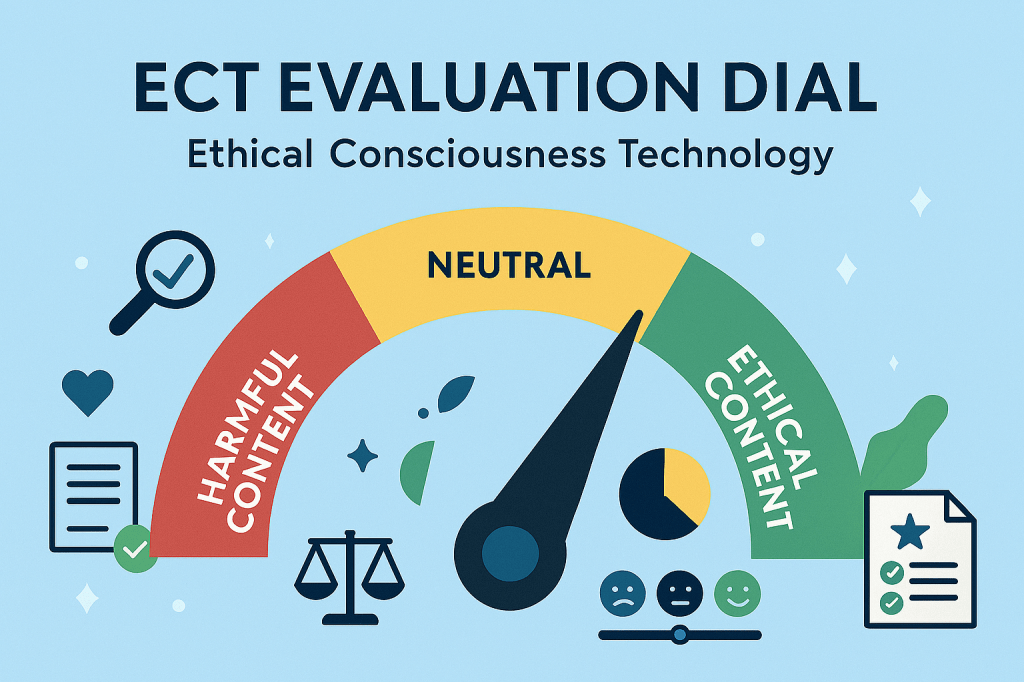
To assess technologies, systems, or organizations based on their adherence to ethical and conscious operation principles. This rubric provides a standardized framework for evaluating any system of influence across five core ethical dimensions.
Pillar 1: Radical Transparency
“Are you honest about what you’re doing?”
Definition
Clear disclosure of intentions, data use, algorithms, business models, and all influence mechanisms.
| Score | Description | Examples |
| 10 | Complete transparency about all influence mechanisms, business model, data use, and decision-making processes | Open-source algorithms, detailed influence disclosure, clear monetization, admits failures openly |
| 9 | Excellent transparency with minor proprietary limitations | Netflix explains recommendation goals, DuckDuckGo privacy stance |
| 8 | Good transparency, some gaps in technical details | Clear privacy policy, business model obvious, some algorithm details withheld |
| 7 | Decent transparency, could be clearer | Privacy policy exists but complex, influence tactics partially disclosed |
| 6 | Basic transparency, meets legal requirements | Standard privacy policy, basic data use disclosure |
| 5 | Minimal transparency, vague disclosures | Unclear monetization, confusing terms of service |
| 4 | Poor transparency, important details hidden | Buried data sharing, unclear business model |
| 3 | Very limited transparency, misleading language | Deceptive “free” claims, vague privacy practices |
| 2 | Deliberately opaque, actively misleading | Hidden fees, false claims about data protection |
| 1 | Completely opaque or deceptive | Secret data harvesting, undisclosed surveillance |
Pillar 2: Empowerment & Agency
“Does this make people stronger or more dependent?”
Definition
Strengthens user autonomy over behavior, choices, and interpretation while reducing dependency.
| Score | Description | Examples |
| 10 | Actively builds user skills, reduces dependency, maximizes autonomous decision-making | Teaching tools, skill-building features, graduation pathways |
| 9 | Strong empowerment focus with comprehensive user control | Customizable interfaces, educational content, user-controlled algorithms |
| 8 | Good empowerment features, some skill-building elements | Export tools, customization options, learning resources |
| 7 | Decent user control, limited skill development | Basic customization, some educational elements |
| 6 | Neutral empowerment, standard user controls | Basic settings, standard features |
| 5 | Limited empowerment, some dependency patterns | Minimal customization, algorithm-dependent experience |
| 4 | Poor empowerment, creates some dependency | Limited user control, designed for frequent return |
| 3 | Weak empowerment, dependency-encouraging design | Streak mechanics, limited export options |
| 2 | Deliberately creates dependency, reduces user agency | Addictive mechanics, removal of user controls |
| 1 | Maximum dependency, eliminates user autonomy | Predatory design, complete algorithmic control |
Pillar 3: Discernment & Manipulation Immunity
“Are you helping people resist manipulation?”
Definition
Helps users resist unhealthy influences, manipulation, and develop critical thinking skills.
| Score | Description | Examples |
| 10 | Actively teaches manipulation recognition, provides immunity tools | Ad blockers with explanations, manipulation education, critical thinking tools |
| 9 | Strong immunity features, educational about influence tactics | Explains why content is recommended, teaches media literacy |
| 8 | Good immunity support, avoids manipulative design | Clean design, factual presentation, some educational elements |
| 7 | Decent immunity, limited manipulation tactics | Minimal psychological triggers, some user education |
| 6 | Neutral design, no manipulation but no immunity building | Standard interface, no particular manipulation tactics |
| 5 | Some subtle manipulation, no immunity support | Mild psychological triggers, no educational content |
| 4 | Uses manipulation tactics, no immunity building | Social proof, artificial scarcity, emotional triggers |
| 3 | Significant manipulation, actively discourages critical thinking | Fear-based messaging, cognitive biases exploitation |
| 2 | Heavy manipulation, undermines user judgment | Addiction mechanics, psychological exploitation |
| 1 | Maximum manipulation, destroys critical thinking ability | Predatory psychological tactics, reality distortion |
Pillar 4: Holistic Well-being
“Does this support overall human flourishing?”
Definition
Supports complete health, mental, emotional, physical, and spiritual, while considering all dimensions of human flourishing.
| Score | Description | Examples |
| 10 | Optimizes for complete human flourishing: mental, physical, social, spiritual | Meditation apps prioritizing peace, wellness-focused design, relationship support |
| 9 | Strong well-being focus across multiple dimensions | Health tracking with context, work-life balance features |
| 8 | Good well-being consideration, minor negative impacts | Positive user experience, some health considerations |
| 7 | Decent well-being support, limited negative effects | Generally positive experience, basic health considerations |
| 6 | Neutral well-being impact, no particular harm or benefit | Standard user experience, no specific well-being focus |
| 5 | Some negative well-being impacts, limited positive effects | Mild stress induction, time-wasting potential |
| 4 | Notable negative well-being effects | Sleep disruption, social isolation, stress creation |
| 3 | Significant harm to well-being | Anxiety induction, relationship damage, health impacts |
| 2 | Serious well-being damage | Mental health deterioration, physical health impacts |
| 1 | Severe harm to human flourishing | Addiction, depression, social destruction |
Pillar 5: Collective Benefit
“Does this make society healthier?”
Definition
Enhances societal awareness, sustainability, ethical systems, and considers environmental and social impact.
| Score | Description | Examples |
| 10 | Significant positive impact on society, communities, environment | Open-source contributions, community building, environmental protection |
| 9 | Strong positive societal impact | Educational platforms, civic engagement tools, sustainability focus |
| 8 | Good societal contribution, minor negative externalities | Job creation, community features, some positive impact |
| 7 | Positive societal impact with some concerns | Economic benefits, limited negative effects |
| 6 | Neutral societal impact, no particular harm or benefit | Standard business practices, neutral community impact |
| 5 | Some negative societal effects, limited positive impact | Minor community disruption, economic inequality contribution |
| 4 | Notable negative societal impacts | Misinformation spread, social division, environmental harm |
| 3 | Significant societal harm | Echo chambers, democracy undermining, significant environmental damage |
| 2 | Serious damage to social fabric | Widespread misinformation, social fragmentation, major environmental harm |
| 1 | Severe societal damage | Democratic destruction, social collapse contribution, environmental devastation |
ECT Score Interpretation Guide
| ECT Score | Classification | Description |
| 9.0–10.0 | Exemplary | Sets the standard for ethical technology |
| 8.0–8.9 | Strong | Excellent ethical practices, minor improvements possible |
| 7.0–7.9 | Good | Generally ethical, some areas for improvement |
| 6.0–6.9 | Moderate | Mixed performance, significant improvements needed |
| 5.0–5.9 | Poor | Below ethical standards, major concerns |
| 4.0–4.9 | Problematic | Significant ethical violations, avoid if possible |
| Below 4.0 | Harmful | Serious ethical violations, recommend against use |
 Ethical Consciousness Technology Home