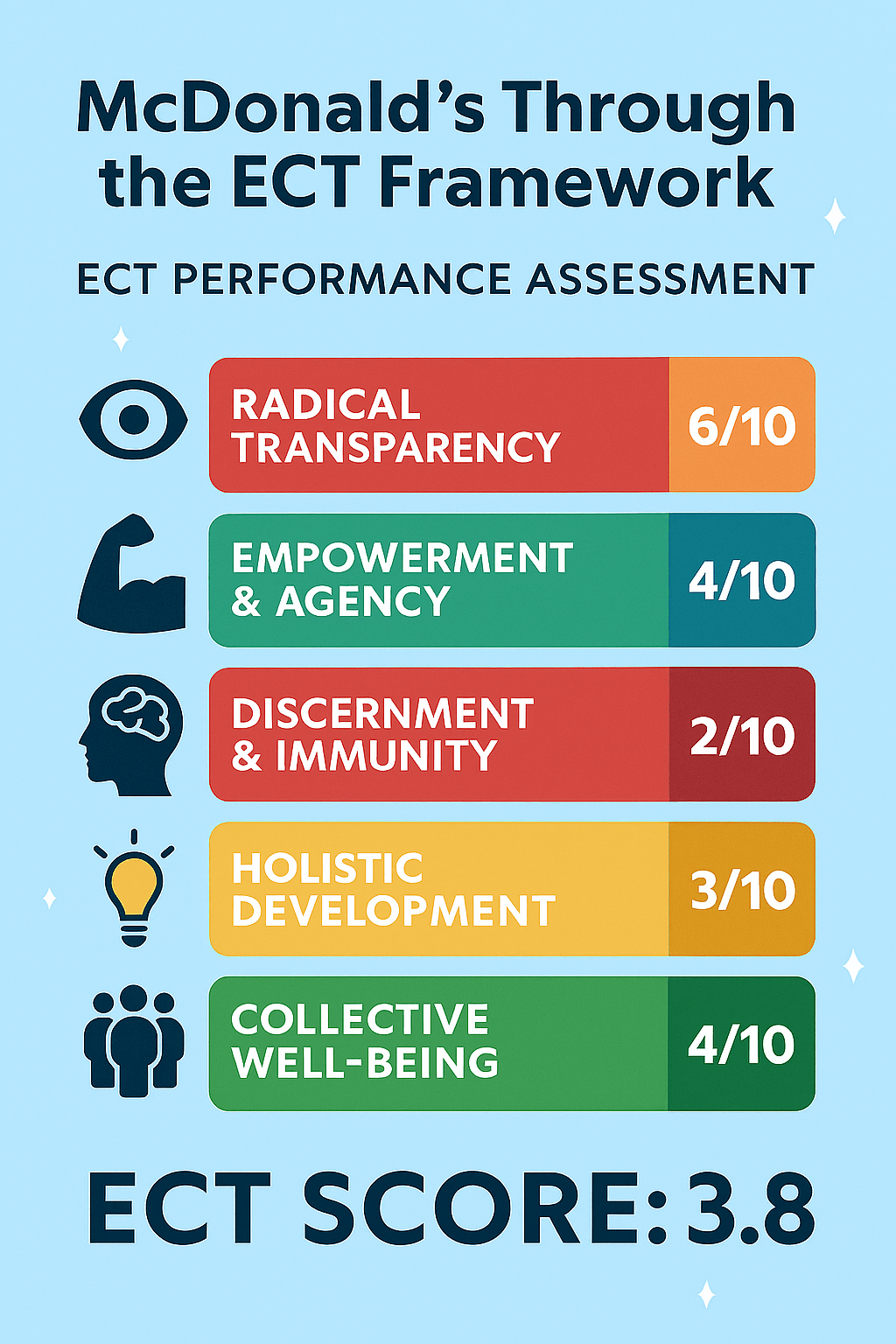
Using the Ethical Consciousness Technology (ECT) framework, we can systematically evaluate how McDonald’s operates as an influence system. This analysis applies ECT’s five core principles to assess whether McDonald’s practices align with ethical consciousness development or represent more problematic influence patterns.
Important Note: This analysis uses McDonald’s as a case study for applying ECT principles, not as a definitive judgment. Different stakeholders may reasonably weight these factors differently based on their values and priorities.
ECT Framework Overview
The ECT framework evaluates influence systems across five dimensions (each scored 1-10):
- Radical Transparency: Open disclosure of influence mechanisms and intentions
- Empowerment & Agency: Strengthening individual autonomy and decision-making capacity
- Discernment & Manipulation Immunity: Building resistance to coercive tactics
- Holistic Development: Considering comprehensive well-being impacts
- Collective Well-Being: Contributing positively to societal health
McDonald’s ECT Analysis
1. Radical Transparency (Score: 6/10)
Strengths:
- Comprehensive nutritional information readily available in-store and online
- Clear pricing and menu transparency
- Publicly available corporate responsibility reports
- Disclosure of major ingredients and sourcing practices
Areas for Improvement:
- Marketing psychology tactics not explicitly disclosed to consumers
- Limited transparency about specific behavioral design elements (store layout, music, scent)
- Complex global supply chain relationships not always immediately accessible
- Algorithmic targeting in digital advertising lacks detailed explanation
Assessment: McDonald’s provides substantial factual transparency but falls short on disclosing the psychological mechanisms designed to influence behavior, particularly in marketing to children.
2. Empowerment & Agency (Score: 4/10)
Strengths:
- Customizable menu options and dietary accommodations
- Mobile ordering provides user control over experience
- Nutritional information enables informed choices
- Employment opportunities and skills development programs
Areas for Improvement:
- Business model fundamentally depends on frequent, habitual consumption
- Limited educational resources about healthy eating or cooking alternatives
- Store design and product formulation optimized for speed and convenience over deliberation
- Marketing creates emotional associations that may bypass rational decision-making
Assessment: While McDonald’s offers some choice and control, the system is primarily designed to encourage dependency and habitual consumption rather than developing customers’ autonomous decision-making about food and health.
3. Discernment & Manipulation Immunity (Score: 2/10)
Strengths:
- Nutritional information allows some comparison shopping
- Regulatory compliance with advertising standards
Areas for Improvement:
- Extensive use of psychological triggers (colors, sounds, scents) without disclosure
- Marketing to children uses developmental psychology insights without immunity-building
- No education about food marketing tactics or how to resist impulse purchases
- Brand associations created through emotional rather than rational appeals
Assessment: McDonald’s marketing and design deliberately employ psychological influence techniques without providing tools for consumers to recognize or resist these tactics. The company makes no effort to build “manipulation immunity” in its customers.
4. Holistic Development (Score: 3/10)
Strengths:
- Provides affordable nutrition access in food deserts
- Significant global employment (over 1.7 million employees)
- Ronald McDonald House Charities supports families in crisis
- Some menu diversification toward healthier options
Areas for Improvement:
- Products linked to increased obesity, diabetes, and cardiovascular disease risks
- Environmental impact from packaging waste and industrial agriculture
- Labor practices often criticized regarding wages and working conditions
- Limited consideration of long-term health impacts in product development
Assessment: While McDonald’s provides employment and affordable calories, its core business model has documented negative impacts on physical health, environmental sustainability, and often worker well-being. The focus remains primarily on short-term satisfaction rather than long-term human flourishing.
5. Collective Well-Being (Score: 4/10)
Strengths:
- Substantial charitable giving through Ronald McDonald House Charities
- Economic development in communities where restaurants locate
- Cultural bridge-building through global presence
- Some sustainability initiatives (renewable energy, waste reduction)
Areas for Improvement:
- Contribution to public health crises (obesity epidemic, diabetes)
- Environmental externalities from industrial food production
- Cultural homogenization concerns in diverse markets
- Limited investment in food system transformation toward sustainability
Assessment: McDonald’s generates significant positive community impact through employment and charity, but this is arguably outweighed by contributions to public health challenges and environmental degradation. The net impact on collective well-being is mixed.
Overall ECT Score: 3.8/10
Calculation: (6 + 4 + 2 + 3 + 4) ÷ 5 = 3.8
Interpretation and Implications
This score suggests McDonald’s operates as a moderately problematic influence system from an ECT perspective. While not entirely extractive or harmful, it falls significantly short of ethical consciousness technology standards.
Key Insights:
- Transparency Gap: McDonald’s provides good factual transparency but lacks disclosure of behavioral influence mechanisms
- Empowerment Deficit: The system is designed more for consumption efficiency than customer empowerment
- Manipulation Blindness: No effort to build consumer awareness of influence tactics
- Mixed Impact: Significant positive contributions (employment, charity) alongside documented negative externalities
Recommendations for Improvement:
- Enhanced Transparency: Disclose marketing psychology tactics, especially in child-targeted advertising
- Empowerment Features: Provide educational resources about nutrition, cooking, and food system literacy
- Immunity Building: Offer tools for recognizing and resisting food marketing manipulation
- Holistic Design: Reformulate products and practices to optimize for long-term health outcomes
- Collective Investment: Increase support for food system transformation and public health initiatives
Framework Limitations
This analysis has several important limitations:
- Scoring Subjectivity: Different evaluators might reasonably assign different scores based on their values and priorities
- Context Dependency: McDonald’s impact varies significantly across different communities and economic contexts
- Complexity Reduction: The framework necessarily simplifies complex systems with multiple stakeholders and competing interests
- Cultural Variation: Ethical standards and priorities vary across cultures and contexts
Conclusion
The ECT framework provides a structured approach for evaluating influence systems, revealing both McDonald’s positive contributions and areas where it falls short of ethical consciousness technology standards. This analysis suggests opportunities for the company to better align its practices with empowerment, transparency, and collective well-being.
Most importantly, this exercise demonstrates how the ECT framework can be applied to systematically evaluate any influence system, providing a foundation for more conscious choices about which systems we engage with and support.
This analysis is intended as an educational exercise in applying ECT principles, not as a definitive judgment of McDonald’s or its practices. Readers are encouraged to apply their own critical thinking and values when evaluating influence systems in their lives.


Leave a comment