Is Your AI Helping You Think, or Just Helping You Scroll?
Millions of people now talk to ChatGPT more than to some of their friends.
It helps write emails, brainstorm ideas, plan trips, and even process emotions. For many, it has quietly become a daily cognitive companion.
But Ethical Consciousness Technology (ECT) asks a different question than most AI evaluations.
Not “Is it smart?”
But “Is it good for your mind?”
ECT is a framework for assessing whether a technology supports healthy consciousness or subtly undermines it over time. It evaluates tools not just by efficiency or accuracy, but by how they shape thinking, agency, discernment, and the shared information environment.
ECT looks at five pillars:
- Radical Transparency
- Empowerment & Agency
- Discernment & Intellectual Friction
- Holistic Development
- Collective Well-Being
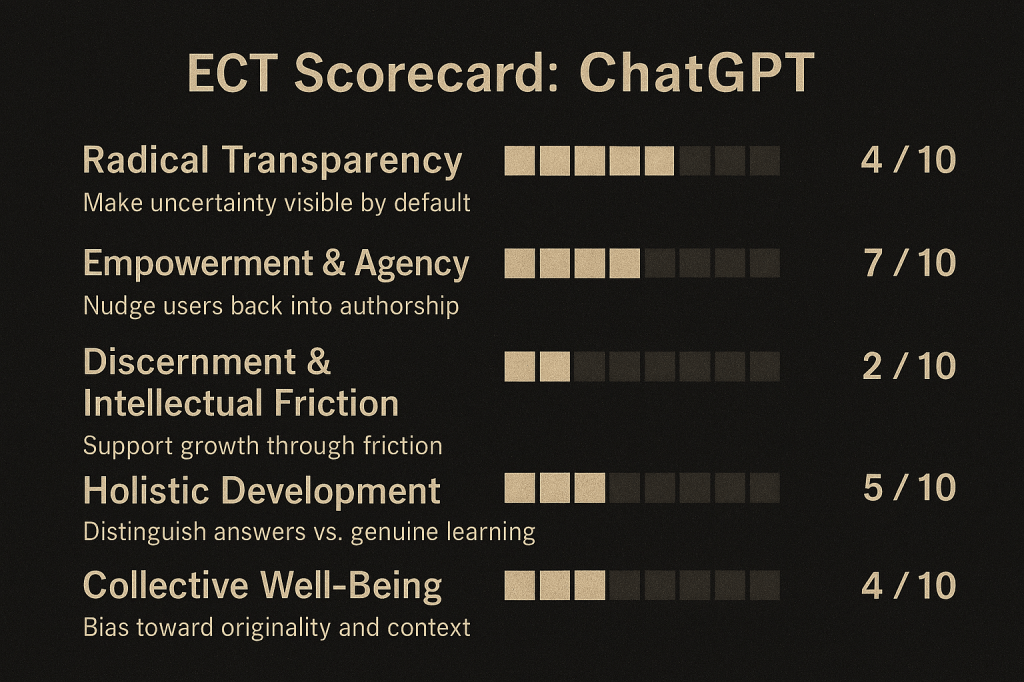
Below is a first-pass scorecard for ChatGPT.
1. Radical Transparency
Score: 4 / 10
Transparency is not just about open-sourcing code. It is about epistemic honesty: clearly communicating what a system knows, what it does not know, and how confident it is in any given response.
ChatGPT remains largely a black-box system. It rarely surfaces where specific claims come from, and “hallucinations” are often delivered in the same confident tone as verified facts. Users cannot see which assumptions are doing the work in an answer, nor whether the model is recalling, inferring, or guessing.
While the system can explain uncertainty or reasoning when explicitly prompted, transparency is optional and user-initiated, not structural or default.
ECT standard:
An ethical consciousness tool would make uncertainty visible by default. It would distinguish confidence levels, flag speculation, surface assumptions, and make the limits of its knowledge legible, without requiring users to know the right questions to ask.
This is less a capability gap than a design choice.
2. Empowerment & Agency
Score: 7 / 10
The core question here is simple:
Does this tool make you more capable, or more dependent?
On the positive side, ChatGPT is a powerful execution engine. It lowers barriers to entry for writing, coding, organizing projects, and translating vague thoughts into structured output. For many users, it meaningfully expands what they can do.
The risk is more subtle. When a system reliably fills every blank page, users may stop practicing the productive struggle that builds judgment, taste, and original insight. Over time, thinking can be outsourced not just at the level of labor, but at the level of intent.
Agency erosion doesn’t happen because the tool is powerful. It happens when the system becomes the default author rather than a collaborator.
ECT standard:
A high-scoring system nudges users back into authorship. It scaffolds thinking without replacing it, encourages users to articulate goals and constraints, and keeps humans in the role of sense-makers rather than mere editors of machine output.
3. Discernment & Intellectual Friction
Score: 2 / 10
A healthy cognitive partner does not merely agree, it challenges.
ChatGPT is optimized to be helpful, harmless, and likable. In practice, this often means it avoids conflict. If a user starts with a flawed premise, the model will frequently proceed within that frame instead of stopping to say, “This assumption is wrong, here’s why.”
Even when it offers counterpoints, they are often symmetrical, polite, and delayed, arriving only after validating the original framing.
The result is a system that feels supportive but rarely sharpens thinking. Local user satisfaction is prioritized over epistemic integrity.
ECT standard:
Ethical tools should support growth through friction. They should flag faulty premises early, offer genuine counter-arguments, and sometimes refuse to continue without reframing the question. Discomfort, when grounded in truth, is not a failure, it is a feature.
4. Holistic Development
Score: 5 / 10
Holistic development asks whether a tool supports long-term flourishing, not just short-term convenience.
ChatGPT excels at efficiency. It saves time, reduces friction, and compresses learning curves. But what it usually optimizes for is speed, not depth. The system defaults to summaries, bullet points, and quick synthesis even when deeper engagement would be more valuable.
There is an important distinction between instrumental use (get the answer) and developmental use (build understanding). ChatGPT can support the latter, but it rarely invites it.
ECT standard:
A more ethical design would distinguish between quick answers and genuine learning. It would sometimes slow users down, point toward primary sources, encourage practice and reflection, and make clear when an output is a shortcut rather than understanding.
5. Collective Well-Being (The “Universal Win”)
Score: 4 / 10
Collective well-being looks at what a tool does to the shared information environment, not just individual users.
ChatGPT dramatically lowers the cost of producing text. This has already contributed to waves of generic, low-quality content, what many now call “AI sludge.” One user gains speed and convenience, while the broader digital commons becomes noisier, flatter, and harder to navigate.
The deeper harm isn’t just volume, it’s homogenization. When everything sounds reasonable, structured, and average, we lose sharpness, voice, and lived specificity.
ECT standard:
A “Universal Win” design would bias toward originality, synthesis, and context. It would help users add signal rather than replicate statistical averages, rewarding insight, specificity, and genuine contribution over sheer output.
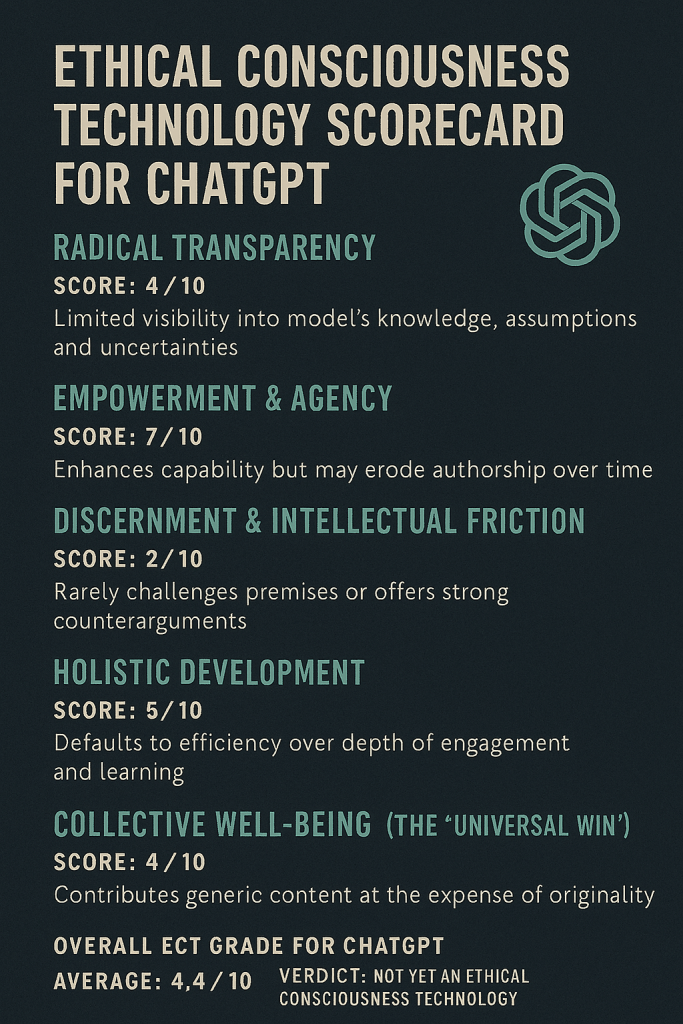
Overall ECT Grade for ChatGPT
Average: 4.4 / 10
Verdict: Not yet an Ethical Consciousness Technology
ChatGPT is extraordinary as an execution layer. It turns instructions into usable artifacts with remarkable speed.
But as a consciousness partner, it is underdeveloped: too opaque, too agreeable, and too focused on frictionless output rather than honest challenge and long-term growth.
The system currently defaults toward broad comfort and alignment, even when integrity would require sharper edges.
How to Use ChatGPT More Ethically (Today)
Until the tools evolve, user behavior is the first line of defense.
- Force transparency: Ask, “How confident are you?” and “What assumptions are doing the work here?”
- Invite friction: Prompt it to “Challenge my argument,” “List ways this could be wrong,” or “Offer the strongest opposing view.”
- Keep authorship: Use ChatGPT to draft and structure, then rewrite in your own judgment and voice. Treat it as a collaborator, not an oracle.
Closing
ECT’s bet is simple:
The future belongs to tools that are not just powerful, but ethical, transparent, empowering, discerning, and aligned with both individual and collective thriving.
This scorecard is a first pass. The next step is to apply the same five pillars to other systems, social media feeds, search engines, creative AI tools, and begin demanding designs that create a universal win, not just a quick fix.
The question isn’t whether AI will shape how we think.
It already does.
The real question is whether we will demand that it does so responsibly.


Leave a comment