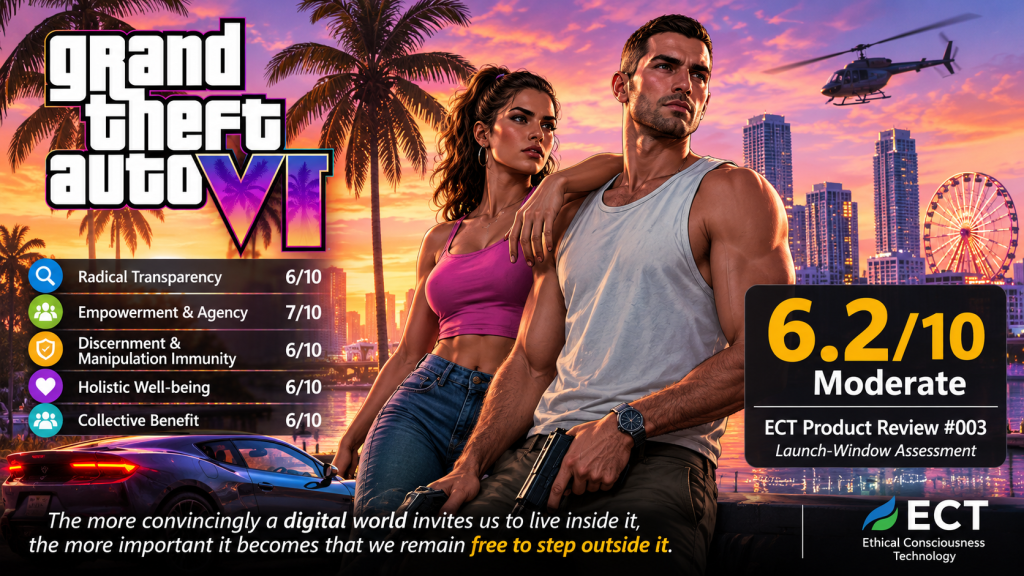
ECT score: 6.2/10 — Moderate
Confidence: Low to moderate
Assessment date: November 21, 2026
Review type: Launch-window product assessment; desk review using official product information and early independent reviews.
This assessment evaluates Grand Theft Auto VI as a consumer product, not Rockstar Games or Take-Two Interactive as companies. It contains no story spoilers and does not claim that ECT has independently completed or exhaustively tested the game.
ECT scorecard
| ECT pillar | Score | Assessment |
|---|---|---|
| Radical Transparency | 6/10 | Clear product and content disclosures, with unresolved questions about data use and future services |
| Empowerment & Agency | 7/10 | Substantial freedom, offline single-player access, and meaningful settings |
| Discernment & Manipulation Immunity | 6/10 | Social satire creates room for reflection, but critical literacy is not the game’s purpose |
| Holistic Well-being | 6/10 | Strong accessibility and entertainment value, balanced against mature content and intense engagement |
| Collective Benefit | 6/10 | Significant creative and cultural contribution, with wider social and environmental effects not yet established |
| Overall ECT score | 6.2/10 | Moderate |
Calculation: (6 + 7 + 6 + 6 + 6) ÷ 5 = 6.2. The standard ECT formula gives each pillar an equal 20% weight. The average does not erase the individual strengths or weaknesses.
Why this score is an early estimate: GTA VI launched on November 19, 2026. This review was prepared only two days later. We have official product disclosures, independent launch reviews, and an early accessibility assessment, but not enough time for a reliable evaluation of long-term play patterns, updates, online services, or the full player experience. The score should be revisited as better evidence becomes available.
1. What are we evaluating?
Grand Theft Auto VI is Rockstar Games’ latest open-world action-adventure game. It takes place in the fictional state of Leonida, including a reimagined Vice City, and follows Jason Duval and Lucia Caminos, partners drawn into a criminal conspiracy. The game launched worldwide on November 19, 2026, for PlayStation 5 and Xbox Series X|S.
The launch version is a single-player experience. The PlayStation listing identifies it as a one-player game and says offline play is enabled. That distinction matters: this assessment is not scoring a live multiplayer economy or a confirmed future online mode. Those would need their own review if and when they become part of the product.
GTA VI is also an unusually influential entertainment product. Its predecessor, GTA V, has sold more than 230 million copies, and the franchise has become a major cultural phenomenon. Reuters reported strong early reviews and estimated sales in the millions within the launch window. The scale of that attention makes the game’s influence worth examining beyond graphics, story, and entertainment value.
Early reviews describe a detailed virtual world that combines criminal action with ordinary activities and relationship-focused storytelling. Ars Technica highlighted the contrast between violent missions and everyday moments, while other reviewers praised the scale, density, and emotional dimension of the world. These are meaningful creative strengths, but immersion itself is not automatically an ethical benefit. ECT asks what that immersion enables, what it asks of players, and how much control they retain.
2. The central ECT question: what happens when a game becomes a place to live?
GTA VI is designed to make a fictional world feel unusually present. Players are not simply moving between missions. They can explore, drive, participate in activities, encounter characters, and spend time in the world outside the main story. Reviewers have described the experience as exceptionally absorbing, with enough incidental detail to keep players exploring long after a mission ends.
That level of immersion can be valuable. A richly made world can support imagination, play, emotional storytelling, shared cultural conversation, and a sense of discovery. But the same qualities can make it difficult to notice how much time an experience is absorbing. The question is not whether a game should be engaging. It is whether the player retains meaningful control over how, when, and why they engage.
GTA VI presents an interesting early case because its launch product is a one-player game with offline play enabled. It does not require a player to participate in a shared competitive economy at launch. That reduces some familiar online-game pressures, although it does not settle questions about the broader Rockstar account ecosystem, future updates, or any later online component.
3. The five ECT pillars
Pillar 1: Radical Transparency — 6/10
ECT question: Are you honest about what you’re doing?
Rockstar and the platform storefronts make several important facts visible before purchase: the game’s platforms, editions, mature-content descriptors, and the presence of in-game purchases. The PlayStation listing identifies the game as one-player and offline-play capable. These disclosures help consumers understand the basic product they are buying.
There is a second layer to transparency: data. Rockstar’s privacy policy, last updated in March 2026, describes information collected across its services. It includes identifiers, purchase and gameplay information, device and platform identifiers, and, depending on the service and settings, potentially sensitive information such as precise location or communications. The policy also describes uses that include service improvement, analytics, marketing, and personalized offers or advertising.
This is relevant context, but it must not be overstated. The policy applies broadly to Rockstar services; it is not a product-specific technical audit of GTA VI. The fact that the game supports offline play also means we should not assume every data practice described for connected services applies identically to every offline session. What remains unclear is the precise data flow for this particular game, which features require an account or connection, and how those choices are presented to players in practice.
Why 6: Basic product, platform, content, and purchase disclosures are available, and Rockstar publishes a substantial privacy policy. The score is limited by the gap between broad policy language and a clear, player-facing explanation of GTA VI-specific data collection, retention, sharing, and controls.
What would improve the score: A concise GTA VI privacy notice explaining exactly what is collected in offline and connected play, which features require an account, what can be disabled, how long data is retained, and how players can exercise their choices.
Pillar 2: Empowerment & Agency — 7/10
ECT question: Does the product strengthen or diminish the user’s ability to make meaningful choices?
The strongest part of GTA VI’s early ECT profile is player agency. The open-world structure gives players room to explore, choose activities, and approach parts of the experience at their own pace. The dual-protagonist structure also gives the story more than one perspective. Reviews describe the ability to switch between Jason and Lucia and a world that rewards curiosity beyond simply following the next mission marker.
Offline single-player play is another meaningful strength. A player can access the core experience without depending on a live multiplayer population or competing with other players for progress. This does not make the game independent of all platform or publisher systems, but it gives the player a degree of control that is increasingly worth recognizing.
Rockstar’s support documentation lists a wide range of settings covering control schemes, controller sensitivity, gameplay and accessibility, display, interface readability, subtitles and captions, camera comfort, and audio. An independent review by the Centre for Accessibility Australia also identifies useful options for motor, vision, hearing, and comfort needs.
There are limits. The game is initially available only on current-generation consoles, and the Centre for Accessibility Australia reports that controls cannot be fully remapped within the game itself. Story missions also remain authored experiences with boundaries and required actions. Freedom inside a designed world is real, but it is not unlimited.
Why 7: A large exploratory world, offline single-player access, dual protagonists, and extensive adjustable settings provide meaningful agency. The score stops short of a higher rating because platform access and some control limitations remain, and the full practical accessibility experience needs more testing.
What would improve the score: More platform availability, fuller native control remapping, continued accessibility improvements, and clear, durable player controls over connected features and future monetization.
Pillar 3: Discernment & Manipulation Immunity — 6/10
ECT question: Does the product support the ability to recognize influence, question claims, and think critically?
Grand Theft Auto has long used satire to examine consumer culture, celebrity, politics, media, status, and the pursuit of wealth. GTA VI continues that tradition. Early reviews point to satirical material involving crypto culture, multi-level marketing, and contemporary social behavior. Its fictional world can create distance from real life, allowing players to notice absurdities and contradictions that might be harder to see when encountered directly.
But satire is not the same as media literacy. A game can parody manipulation without teaching players how to identify persuasive techniques, verify information, recognize conflicts of interest, or distinguish evidence from spectacle. The meaning of satire also depends on interpretation. Some players may recognize the target of a joke; others may simply experience the spectacle or absorb the caricature.
ECT should not penalize GTA VI for failing to become an educational product. The relevant question is whether its design actively undermines discernment or offers meaningful opportunities to reflect. At launch, there is evidence of social commentary, but not enough to claim that the game systematically builds players’ resistance to manipulation.
Why 6: The satire and cultural observation offer some opportunities for critical distance, but they are not a structured discernment system. The score recognizes the positive potential without confusing entertainment with media-literacy education.
What would improve the score: More consistently thoughtful satire, richer consequences for choices, and optional contextual material that helps players examine the real-world systems being parodied without turning the game into a lecture.
Pillar 4: Holistic Well-being — 6/10
ECT question: Does the product support a healthy relationship with the player’s time, attention, emotions, and broader life?
Games can contribute to enjoyment, relaxation, creativity, social connection, and emotional storytelling. GTA VI’s early reviews describe a world with quieter activities and relationship moments alongside its familiar action. The accessibility settings also deserve credit: adjustable text and interface elements, subtitles and captions, screen narration, high-contrast options, camera and visual-effect controls, and audio adjustments can make play more comfortable for a wider range of people.
There are meaningful limits. The game carries mature-content descriptors for intense violence, blood and gore, nudity, strong sexual content, strong language, and drug and alcohol use. Those elements are not hidden surprises; they are disclosed as part of the product’s rating. They do, however, make age-appropriate use and individual sensitivity important considerations.
There is also the question of time and attention. Reviewers have described the world as deeply absorbing, and the scale of the experience invites long sessions. That can be part of the appeal, but an experience that is easy to lose oneself in can compete with sleep, responsibilities, and other activities. This is a design consideration, not proof that every player will develop unhealthy habits.
The accessibility review also identifies shortcomings: the screen reader is limited in where it works and is available only in English, while controls cannot be remapped inside the game. These are practical barriers for some players, even though the overall range of settings is a positive step.
Why 6: The game’s accessibility work and broad entertainment value are genuine positives. Mature content, intense immersion, and remaining accessibility gaps keep the assessment in the moderate range.
What would improve the score: More comprehensive screen-reader support, broader control customization, accessible options across all gameplay contexts, and design choices that help players manage time and intensity without undermining the experience.
Pillar 5: Collective Benefit — 6/10
ECT question: Does the product contribute positively beyond the immediate transaction?
GTA VI is a major creative work with a substantial cultural footprint. Its world-building, performances, music, writing, and technical ambition contribute to the evolution of interactive entertainment. The portrayal of Lucia as a central protagonist also broadens the series’ perspective, and launch reporting includes players describing the importance of seeing a character with whom they identify.
The game’s cultural reach can create shared experiences and conversations well beyond the people playing it. The release has already generated public events, media coverage, fan creativity, and discussion about representation, storytelling, and the place of games in popular culture. These are real forms of collective value, although popularity alone is not proof of social benefit.
The wider costs are harder to assess. A production of this scale uses significant creative labor, computing resources, physical infrastructure, and distribution systems. The public evidence reviewed for this launch-window assessment is not sufficient to calculate the game’s full environmental footprint or to make a comprehensive judgment about working conditions across its development and supply chain. Those questions matter, but they should not be answered by speculation or by automatically transferring a company-wide judgment onto this individual product.
Why 6: The game’s creative and cultural contribution is substantial, and its representation and accessibility work have positive value. The score remains moderate because the wider social, labor, and environmental effects are not yet sufficiently documented in this product-specific review.
What would improve the score: More transparent reporting on production sustainability, accessibility outcomes, labor practices relevant to the title, and the long-term cultural and community effects of the product.
4. The wider questions ECT should keep watching
Online services and future monetization. The launch product is a one-player, offline-play-capable experience. That is the basis of this score. If Rockstar later introduces a multiplayer component, subscriptions, virtual currency, recurring purchases, or other connected systems, those features should be evaluated on their own evidence. A future online economy could materially change the agency, transparency, discernment, and well-being scores.
Privacy in practice. Rockstar’s general privacy policy describes broad data practices across its services. A more specific explanation of what GTA VI collects in offline and connected contexts would make it easier for players to understand the trade-offs. The policy should be read as a company-wide disclosure, not as proof that every listed category is collected in every GTA VI session.
Accessibility beyond the settings menu. A long list of options is encouraging, but the real test is whether people with different disabilities can use the game comfortably from beginning to end. The early specialist review is useful because it identifies both strengths and concrete limitations. More independent testing should follow.
Immersion and attention. GTA VI demonstrates how powerful a digital environment can become when it is rich enough to feel like somewhere a person can spend time, not merely a sequence of objectives. That is an artistic achievement. It is also a reason to ask whether the player remains in charge of the relationship with the game.
5. Overall assessment: 6.2/10
Grand Theft Auto VI appears to be an exceptional entertainment product. Its open world, storytelling, character work, and technical ambition have received extraordinary early praise. From an ECT perspective, its strongest feature is the amount of meaningful freedom it gives players within a single-player world, supported by offline play and a substantial set of accessibility and comfort settings.
The more cautious parts of the assessment concern transparency around product-specific data practices, the limits of satire as a tool for discernment, the intensity of an experience designed to hold attention, and the lack of mature evidence about its wider social and environmental effects.
A 6.2 does not mean the game is ethically bad, nor does its critical acclaim make it ethically exemplary. ECT is examining a different question from a conventional game review: not only whether the experience is impressive, but how it treats the person experiencing it.
The central tension is this: the more convincingly a digital world invites us to live inside it, the more important it becomes that we remain free to step outside it.
6. What could change this score?
- Independent testing of privacy and data flows in offline and connected play.
- Longer-term evidence about player well-being, time use, and engagement design.
- Broader accessibility testing with players with different disabilities.
- Clear details about any future online mode, subscriptions, virtual currency, or recurring monetization.
- Better evidence about the product’s production footprint and title-specific labor conditions.
These are not assumptions that the game has failed in those areas. They are the questions that remain open. If new evidence supports a different conclusion, the score should change.
Sources and further reading
- Rockstar Games, Grand Theft Auto VI Now Available (November 19, 2026).
- Rockstar Games, How to change Grand Theft Auto VI settings (November 18, 2026).
- Rockstar Games, Privacy Policy (last updated March 2026).
- PlayStation, Grand Theft Auto VI product listing (accessed November 21, 2026).
- Centre for Accessibility Australia, Grand Theft Auto VI Accessibility Review: What Works and What Needs Improving (November 20, 2026).
- Ars Technica, Grand Theft Auto VI: The Ars Technica Review (November 18, 2026).
- TechRadar, Grand Theft Auto 6 review (November 18, 2026).
- The Guardian, Grand Theft Auto VI review (November 18, 2026).
- Reuters, Grand Theft Auto VI draws rave reviews as gamers enter Vice City (updated November 20, 2026).
- Ethical Consciousness Technology, ECT 101, General ECT Rubric, and How We Score ECT.
AI-use note: AI tools assisted with research organization, source discovery, drafting, and editing. The author reviewed the material and is responsible for the final analysis and scores.
Assessment status: Launch-window desk review. ECT has not independently purchased, completed, or exhaustively tested GTA VI. Confidence is low to moderate because the game has been available for only two days. This assessment should be revisited as longer-term evidence and any new product features become available.
How to read this assessment
This scorecard is our current assessment, not an authoritative verdict. The numbers summarize our interpretation of available evidence through the ECT framework; they are not scientific measurements or objective facts about a product’s moral worth. Readers should inspect the evidence, challenge our reasoning, and use the General Rubric to make their own assessment.
Our conclusions can change. New evidence, changes to the product, alternative interpretations, and revisions to the ECT framework may lead us to update the analysis or scores. We aim to explain meaningful revisions rather than treat an earlier number as permanent.
The ultimate goal is not agreement. It is awareness.


Leave a Reply