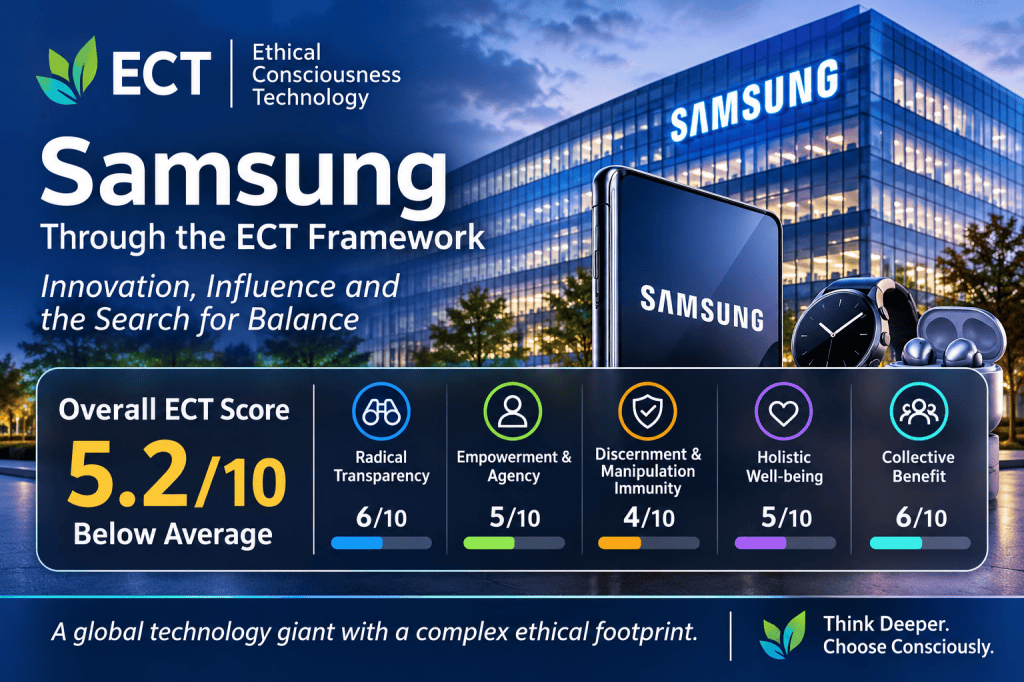
ECT score: 5.2/10 — Below Average
Company-wide assessment | November 23, 2026 | ECT General Rubric v1.1 | Confidence: Moderate
Assessment subject: Samsung Electronics Co., Ltd., including its Device eXperience businesses, smartphones and connected devices, televisions and appliances, semiconductors, displays, networks, and Harman businesses. This is not a score for the wider Samsung Group, nor a review of one Galaxy phone or other individual product.
Samsung occupies an unusual position in the technology economy. It is both a consumer-facing brand and a major industrial supplier. Its devices shape everyday communication, entertainment, and home life, while its memory chips, displays, and other components support products and infrastructure across the global technology sector. Its influence is therefore not limited to the people who buy a Galaxy phone or television.
That reach creates real benefits: advanced hardware, broad product choice, long-running software support commitments, manufacturing scale, and technologies that enable other companies. It also raises questions about privacy, ecosystem dependence, labor relations, environmental costs, transparency, and the concentration of critical technology supply.
ECT asks a question beyond whether Samsung makes useful products or performs well financially: how responsibly does the company use the influence it has over people, markets, information, workers, and the systems they depend on?
This is a structured assessment of publicly available evidence, not an independent audit of Samsung’s operations or a hands-on test of every product. Company-reported achievements are identified as company-reported. Independent benchmarks, regulatory records, court decisions, and credible reporting are used where available. Allegations and unresolved proceedings are not treated as established misconduct.
1. Samsung’s ECT scorecard
| ECT pillar | Score | Assessment |
|---|---|---|
| Radical Transparency | 6/10 | Substantial corporate, sustainability, and privacy disclosures, but important gaps remain in platform governance, algorithmic systems, and government data requests. |
| Empowerment & Agency | 5/10 | Broad device choice, Android flexibility, repair pathways, and user controls coexist with ecosystem dependence, account requirements, and limited control over some platform decisions. |
| Discernment & Manipulation Immunity | 4/10 | Advertising and recommendation practices are not explained with enough operational detail for users to consistently understand how commercial and algorithmic influence shapes their experience. |
| Holistic Well-being | 5/10 | Accessibility, device safety, and support features offer meaningful benefits, while attention, data, repair, labor, and environmental impacts remain mixed. |
| Collective Benefit | 6/10 | Samsung enables important digital and industrial infrastructure and reports measurable environmental and supplier initiatives, but the scale of its manufacturing footprint and unresolved social impacts temper the benefit. |
Overall ECT score: 5.2/10 — Below Average. The five pillars are weighted equally at 20% each. The score is the arithmetic average: (6 + 5 + 4 + 5 + 6) ÷ 5 = 5.2.
Confidence: Moderate. Samsung publishes extensive financial, privacy, and sustainability information, and independent digital-rights research provides a useful external check. However, public evidence remains uneven across its many divisions, supplier tiers, products, and markets. This assessment is a reasoned interpretation, not a measurement with scientific precision.
2. What are we evaluating?
Samsung Electronics is not simply a smartphone manufacturer. Its Device eXperience (DX) division includes mobile devices, televisions, home appliances, and related services. Its Device Solutions (DS) division includes memory, system LSI, and foundry operations. Samsung Display, networks, and Harman add further reach across consumer, enterprise, automotive, and industrial markets.
The company’s third-quarter 2026 results illustrate the scale and strategic importance of that position. Samsung reported consolidated revenue of KRW 195.3 trillion and operating profit of KRW 107.4 trillion. Its Device Solutions division accounted for KRW 147.1 trillion in revenue and KRW 106.5 trillion in operating profit, with record memory performance driven in part by AI-related demand. By contrast, the DX division recorded an operating loss of KRW 0.8 trillion. These are company-reported financial results, not an ethical score, but they show how much of Samsung’s current economic influence is tied to semiconductor and AI infrastructure demand.
The assessment considers the company’s influence as a whole. It does not assume that every product shares the same privacy settings, environmental profile, or user experience. Nor does a positive result in one division automatically offset a serious weakness in another. The purpose is to evaluate the broad influence system while making the limits of the available evidence visible.
3. The five ECT pillars
Pillar 1: Radical Transparency — 6/10
Samsung provides substantial public information about its business, financial performance, privacy practices, sustainability strategy, and supplier expectations. Its 2026 Sustainability Report describes environmental targets, energy use, water stewardship, supplier audits, and social initiatives. Its U.S. privacy policy, effective July 20, 2026, describes categories of personal information and uses that apply across devices and services for U.S. residents.
Those disclosures matter. The 2026 sustainability report says the DX division used renewable energy for 94.8% of its energy consumption at the end of 2025, while also reporting a 67.2% water replenishment rate and 33.7% recycled plastic content in relevant product components. Samsung also says it expanded third-party supplier audits to 122 first-tier and 39 second-tier suppliers. These are useful reported metrics, although they remain company-reported results and should not be confused with a full independent assessment of every site or supplier.
The independent Ranking Digital Rights 2025 Big Tech Edition offers a more critical view of Samsung’s digital-platform disclosures. It ranked Samsung 12th among 14 companies with an overall score of 28%. RDR identified gaps in transparency about government requests for user data, content and account restrictions, algorithmic systems, and internal governance. Importantly, the index evaluated policies active on August 1, 2024, so it does not fully reflect Samsung’s later privacy-policy revisions or 2026 disclosures. It remains a useful baseline, not a current audit of every policy.
Samsung’s updated privacy materials and its SmartThings notice show that the company is disclosing more detail about connected-device information, account data, app use, network information, and certain home-device activity. This is particularly important because connected appliances and sensors can reveal patterns about a household, not merely ordinary product preferences. The SmartThings notice explains that some device and usage information is processed to provide requested services and improve them, with certain customized marketing uses subject to separate consent.
Why 6? Samsung’s reporting is substantial and has improved in important areas. But transparency is not measured by the volume of PDFs alone. Users and outside researchers still need clearer explanations of platform governance, algorithmic recommendation, advertising, and how authorities’ requests for user information are handled. The independent benchmark’s findings are significant, even with its older policy cutoff.
What would improve the score? Publish a regular transparency report covering government and private requests, content and account restrictions, and appeals. Explain the governance and practical operation of recommendation and ranking systems. Make privacy explanations easier to compare across Galaxy, SmartThings, television, and advertising services.
Pillar 2: Empowerment & Agency — 5/10
Samsung offers consumers a wide range of devices and price points, and its use of Android gives users access to a large app ecosystem. Galaxy devices include settings for permissions, privacy, accessibility, notifications, and account management. Samsung also provides self-service and repair-related information in some markets, while its component and manufacturing businesses give other companies access to important technologies.
However, choice at the point of purchase is not the same as meaningful agency throughout a product’s life. Samsung accounts, Galaxy Store policies, preinstalled services, proprietary features, and connected-device integrations can create practical dependence. Moving between brands or ecosystems may involve losing settings, integrations, service history, or familiar workflows. These frictions do not make the ecosystem inherently unethical, but they matter when evaluating how easily a user can leave or meaningfully customize the experience.
RDR’s 2025 assessment found weaknesses in Samsung’s governance, user notification, identity, and appeals disclosures. It also noted that Samsung’s implementation of Android lagged behind peers in several freedom-of-expression and privacy categories. The report described a requirement for users of Samsung services in South Korea to provide a phone number as a privacy-relevant identity-policy concern. Because the benchmark’s policy cutoff was August 2024, this finding should be treated as evidence about the policies evaluated then, not automatically as a description of every current market or service.
Samsung’s July 2026 U.S. privacy supplement also says personal information may be used to develop and train AI algorithms and models, in addition to the other uses described in its policy. That disclosure is relevant to agency: people need to understand which services and data practices are involved, what choices are available, and whether declining a use meaningfully limits functionality. The policy also distinguishes certain biometric information that remains stored on the user’s device and is not accessible to Samsung. These distinctions are useful, but they require users to navigate policy language and service-specific settings to understand the practical consequences.
Why 5? Samsung provides genuine choice, customization, and useful controls, but the user’s ability to shape the broader ecosystem is more limited than the range of available products might suggest. Agency is mixed: strong at the device-selection level, less consistent at the platform and data-governance levels.
What would improve the score? Make default settings and optional data uses easier to understand, reduce unnecessary account dependence, improve portability between Samsung services and competing ecosystems, and provide consistent user-facing explanations and appeals across Galaxy Store and connected services.
Pillar 3: Discernment & Manipulation Immunity — 4/10
This pillar examines whether a company helps people recognize commercial influence, understand how recommendations shape choices, and evaluate information independently. It does not require a company to teach a full media-literacy course. It does require that important persuasive and algorithmic systems not remain needlessly opaque.
Samsung operates advertising and recommendation experiences across parts of its consumer ecosystem, including television and connected services. Its privacy materials describe personalized advertising and the use of information about online activity, preferences, and interests in certain services. Samsung’s U.S. privacy supplement explains that Samsung Ads can serve personalized advertising on Samsung and third-party platforms, devices, websites, and apps.
Personalized advertising is not automatically manipulation. It can make advertising more relevant and help fund services. The ECT concern is whether people can identify the commercial purpose, understand why they are seeing a recommendation, and exercise meaningful control over profiling and personalization. The RDR assessment identified a lack of operational disclosure around algorithmic curation and recommendation systems, as well as gaps in targeted-advertising rules and government-request transparency. Its cutoff means newer disclosures should be considered, but the public evidence still does not provide a sufficiently clear picture of how these systems operate in practice.
Samsung’s AI ambitions add another dimension. The company’s 2026 financial results describe expanding AI-driven semiconductor demand and its own plans to extend AI-based experiences across devices and appliances. AI features can support productivity, accessibility, translation, and convenience. They can also make it harder for users to distinguish generated content, sponsored recommendations, automated suggestions, and neutral information unless the interface clearly communicates what is happening.
Why 4? The available evidence supports concern about insufficient transparency around algorithmic influence and personalized advertising. This is not a claim that Samsung has been proven to manipulate users, nor that every recommendation is harmful. The lower score reflects the gap between the influence these systems can have and the public detail available for users and independent researchers to evaluate them.
What would improve the score? Provide point-of-use explanations for sponsored placements and recommendations, disclose the main factors shaping personalization, offer simple controls that actually change the experience, and publish meaningful information about algorithmic governance and independent evaluations.
Pillar 4: Holistic Well-being — 5/10
Samsung’s products can support well-being in practical ways. Smartphones and wearables provide communication, accessibility tools, health-related features, emergency functions, and connections to services. TVs and appliances can improve convenience and accessibility at home. The company also provides device security updates and product support information, although support duration and availability vary by product and market.
There are also costs and risks. Smartphones, televisions, and connected devices compete for attention and can contribute to distraction or extended screen use. Personalized advertising and connected-home data create privacy questions. Repairability, battery replacement, product longevity, and electronic waste influence the long-term consequences of ownership. These are not unique to Samsung, but the company’s scale makes its choices consequential.
Workplace well-being also belongs in a company-wide assessment. In 2026, Samsung faced significant labor tensions in South Korea over compensation and performance bonuses. Reuters reported that unions authorized strike action and that the company sought court intervention concerning alleged unlawful strike activity. A subsequent government-mediated agreement averted the planned 18-day strike, while a separate union representing consumer-electronics workers challenged the voting process in court. These events do not by themselves establish that Samsung violated workers’ rights. They do show that labor relations and the distribution of the benefits of the AI-driven profit surge remain active issues rather than settled matters.
Why 5? Samsung’s technology creates real quality-of-life and accessibility benefits, but well-being is broader than product usefulness. The evidence presents a mixed picture across attention, privacy, repair, environmental burden, and labor relations. There is not enough basis to claim universal harm, but neither is there enough to award a strong positive score.
What would improve the score? Make repair and long-term support more consistent, strengthen transparent controls over attention and advertising, report measurable worker-safety and labor outcomes, and demonstrate that AI and connected-device features improve user outcomes without imposing avoidable privacy or attention costs.
Pillar 5: Collective Benefit — 6/10
Samsung’s contribution to collective benefit is substantial. Its semiconductor, display, mobile, network, and appliance businesses support global communications, computing, manufacturing, research, and consumer access to technology. Memory and advanced semiconductor products are important to data centers and AI infrastructure. Its scale can accelerate innovation and make advanced technologies available across a broad market.
The environmental record is mixed but includes measurable initiatives. Samsung’s 2026 Sustainability Report states that its DX division reached 94.8% renewable-energy use by the end of 2025 and reports progress in water replenishment and recycled plastics. It says the Device Solutions division is pursuing net-zero Scope 1 and 2 emissions by 2050, while the DX division targets 2030. The report also describes supplier audits and a supply-chain sustainability committee. These efforts deserve credit, but they are company-reported programs and do not erase the energy, water, materials, and emissions demands associated with semiconductor manufacturing and global electronics production.
There is also a question of distribution. Samsung’s third-quarter 2026 results show extraordinary profitability in memory and AI-related businesses, while other divisions faced operating losses and cost pressures. That financial contrast does not prove unfairness, but it makes the treatment of workers, suppliers, customers, and communities especially relevant. The labor disputes over bonuses and compensation illustrate that the benefits of a booming business do not automatically reach every part of the workforce in the same way.
Legal disputes should be handled carefully. In August 2026, the U.S. International Trade Commission instituted an investigation into certain mobile electronic devices in response to a patent complaint naming Samsung Electronics and Samsung Electronics America among the respondents. The USITC explicitly stated that instituting the investigation was not a decision on the merits. This assessment does not treat the allegations as proven infringement. It is included only as an example of the legal and competitive pressures surrounding a company operating at Samsung’s scale.
Why 6? Samsung enables important technologies and reports meaningful environmental and supplier initiatives. Its collective contribution is real, but the scale of its manufacturing footprint, the uneven distribution of economic gains, and continuing questions about supply-chain and labor outcomes prevent a stronger score.
What would improve the score? Publish more independently verifiable, site-level environmental data; extend supplier due diligence and public reporting beyond selected tiers; demonstrate measurable improvements in worker outcomes; and make advanced technologies more interoperable and broadly beneficial.
4. Overall assessment: an essential technology supplier with uneven accountability
Samsung’s 5.2/10 score reflects a company with substantial technological and economic contributions, but whose transparency and accountability have not kept pace consistently with the reach of its ecosystem. Its strongest ECT areas are transparency and collective benefit, where substantial reporting and important infrastructure contributions are visible. Its weakest area is discernment, where the public still lacks enough operational clarity about recommendation systems, targeted advertising, and algorithmic influence.
This is not a verdict that Samsung’s products are bad or that consumers should avoid them. A Galaxy phone may be an excellent choice for one person. A Samsung memory component may be essential to a product that delivers significant social value. A household may benefit from the convenience of SmartThings. Those product-level judgments are different from asking how responsibly the corporation uses its overall influence.
Samsung also demonstrates why company-wide assessments need nuance. A business can make meaningful progress on sustainability and privacy while still falling short on transparency in other areas. It can expand user choice through product variety while creating dependence through ecosystem design. It can generate extraordinary economic value while facing unresolved questions about labor, environmental costs, and who benefits from growth.
5. What would raise Samsung’s ECT score?
- Make algorithmic influence understandable. Publish clear explanations of recommendations, ranking, personalization, and advertising across the Samsung ecosystem.
- Improve transparency reporting. Disclose government and private requests for user information, content restrictions, account actions, and appeal outcomes.
- Strengthen practical agency. Make data choices, account requirements, service portability, and connected-device controls easier to understand and use.
- Demonstrate responsible AI governance. Explain where AI systems are used, what data supports them, how people can challenge outputs, and how risks are assessed.
- Show independently verifiable supply-chain progress. Expand public reporting on labor conditions, worker voice, safety, corrective actions, and environmental impacts beyond first-tier suppliers.
- Distribute the benefits of growth responsibly. Demonstrate that extraordinary returns in strategic businesses translate into fair labor practices, resilient suppliers, and wider public benefit.
6. Evidence, limitations, and confidence
Confidence: Moderate. The assessment draws on Samsung’s 2026 financial results, 2026 Sustainability Report, current U.S. privacy policy and SmartThings notice, the 2025 Ranking Digital Rights benchmark, official USITC case information, and Reuters reporting on labor negotiations. The evidence is strongest for financial scale, stated policies, and the existence and procedural status of public legal or labor events. It is weaker for actual user outcomes, the real-world effectiveness of privacy controls, the operation of recommendation systems, and conditions throughout complex supplier networks.
Important source distinction: Samsung’s sustainability and privacy reports are primary sources for what the company says it does and the policies it publishes. They are not independent proof that every target has been met or that every control works as intended. Ranking Digital Rights is an independent policy benchmark, but its 2025 Samsung assessment used policies active on August 1, 2024. Reuters provides independent reporting on labor developments; the USITC is the authoritative source for the status of the patent investigation. The assessment does not treat pending allegations as final findings.
Sources and further reading
- Samsung Electronics, Third Quarter 2026 Results, October 29, 2026 — financial performance, business divisions, AI-related memory demand, capital expenditure, and outlook.
- Samsung Electronics, 2026 Sustainability Report announcement, June 26, 2026 — company-reported environmental, supplier, and social initiatives.
- Samsung, U.S. Privacy Policy and Supplement, effective July 20, 2026 — U.S. consumer data practices, AI development and training uses, biometric information, and personalized advertising.
- Samsung SmartThings Privacy Notice, effective September 21, 2026 — account, app, connected-home device, and usage information.
- Ranking Digital Rights, Samsung: 2025 Big Tech Edition — independent assessment of governance, freedom of expression, privacy, and transparency. The evaluated policies were active on August 1, 2024.
- Ranking Digital Rights, 2025 Big Tech Edition: Executive Summary — benchmark methodology and cross-company findings.
- U.S. International Trade Commission, Investigation 337-TA-1516, August 12, 2026 — official notice that a patent investigation was instituted, with no decision on the merits at that stage.
- Reuters, Samsung labor dispute and planned strike, April 16, 2026 — reporting on union demands, company response, and the legal dispute.
- Reuters, Samsung consumer-electronics union challenges pay-deal vote, May 26, 2026 — reporting on the separate union’s challenge after a mediated agreement.
- Samsung Electronics, 2025 Annual Report, filed March 10, 2026 — company filing and financial disclosures through the Korean Financial Supervisory Service’s DART system.
- ECT General Rubric, How We Score ECT, and ECT 101 — framework and scoring method.
How to read this assessment
ECT scores are structured judgments based on evidence and explicit criteria. They are not objective measurements of a company’s moral worth, and they are not instructions about what readers should buy. Another evaluator may reasonably assign different scores based on the evidence selected, the weight given to particular harms or benefits, and their own circumstances.
The point is not to demand agreement. It is to make the reasoning visible enough to challenge. Readers are encouraged to examine the sources, question the scoring, and conduct their own assessment. ECT is an invitation to think, not an authority on what to think. The ultimate goal is not agreement. It is awareness.
AI-use note: AI tools assisted with research organization and drafting. The author is responsible for the final analysis, source selection, interpretation, and scores. Company-reported claims, independent research, legal records, and reported events are distinguished in the assessment.
Samsung’s influence reaches from the device in a person’s hand to the components inside the world’s digital infrastructure. The question is not whether that influence is valuable. It clearly is. The question is whether the people and communities affected by it have enough transparency, agency, and accountability to share in its benefits.


Leave a Reply